The New Rules of B2B Marketing — Actionable Takeaways from Digital Summit Chicago
Key Highlights
- Why trust — not volume or automation — is becoming the most important competitive advantage in B2B marketing
- The frameworks marketers can use to stay relevant as AI reshapes discovery, attention and decision‑making
- How audio, video, storytelling and AI visibility are converging into a more human‑first marketing strategy

There’s a particular kind of energy that only happens when people who spend most of their time communicating through screens finally end up in the same room. It’s a little like meeting a long-distance friend for dinner. You’ve been following each other’s work, reading each other’s takes, nodding along to the same ideas from opposite sides of a laptop. And then suddenly you’re at the same table, and the conversation picks up like no time has passed at all.
That’s what Digital Summit Chicago felt like. Two days at the Marriott Marquis with a few hundred marketers who’ve all been quietly wrestling with the same questions: How do we stay visible when AI is rewriting the rules of discovery? How do we stay human when content has never been cheaper or more abundant? How do we keep doing work that actually matters?
The sessions didn’t all agree on the answers. But they were asking the right questions, and a few of them said things worth carrying back to the office. Here are some of the sessions I was lucky enough to addend.

Why the Future of Media is Sound-On and What It Means for Marketers
Speaker: Jenny Haggard, Spotify
In Brief: This keynote session explored the results of recent Spotify original research — drawn from 5,000 consumers, 105 marketers and 30 expert interviews — arguing that audio has become a foundational marketing channel rather than a supplementary one, and that brands without a deliberate sound-on strategy are already falling behind. The most important argument is not that audio is growing, but that consumer behavior has already shifted: 86% of Spotify users are actively silencing video on other platforms to engage with audio, and marketers are seeing measurable performance advantages from audio, including a reported 4–8x ROI in media mix modeling studies. The session was framed around two emerging currencies in an AI-saturated environment — trust and human taste — and closed with a practical three-question framework (What are the sounds of my brand? What does my brand sound like? Where is my brand being heard?) designed to help practitioners build a sound-on strategy without necessarily increasing budget.
Quote: “Sound is no longer nice to have. It needs to be a foundational part of all of our marketing plans. That statement wasn’t true five years ago. It’s true today.”
Actionable Item: Sound-On Framework (What are the sounds of my brand? What does my brand sound like? Where is my brand being heard?) Provides a structured starting point that doesn’t require a large budget or audio-specific expertise to begin.
Key Takeaway: Audio is no longer a channel to add to the media mix — it is a strategic layer that should sit above all marketing formats. The brands that treat it that way now, while competitors are still optimizing for screens, are the ones most likely to build durable trust and attention in an AI-saturated environment.
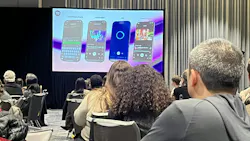
Video That Moves Pipeline: How to Drive Revenue Impact with LinkedIn Video Across the Full Funnel

Speaker: Purna Virji, LinkedIn
In Brief: B2B marketers are still operating in 2024 mode while buyer behavior has fundamentally shifted toward video and social media discovery (AI #1, social media #2), making traditional awareness-stage marketing ineffective — 81% of B2B ads now fail to gain attention. The answer is a three-play integrated approach:
- Reach and Prime with cut-through creative that builds awareness across the full buying group using diverse formats.
- Educate and Nudge focused on viability and trust rather than capability, staying always-on with content that addresses buyer concerns.
- Remove Friction through social proof and expert voices that reduce execution, decision and risk.
Purna claims this integrated approach drives 1.4x more leads based on LinkedIn research of 13 million creatives, supported by specific data about format effectiveness.
Quote: "People just want to hear from other people. You don't even need me to tell you about social proof — you know how important it is."
Actionable Item: Three-Play Integrated Approach — Reach and Prime (cut-through creative for full buying group), Educate and Nudge (address buyer concerns, not just features), Remove Friction (leverage social proof and expert voices). This concrete, phased framework directly maps to B2B buying cycles (awareness → consideration → decision).
Key Takeaway: B2B marketers need to stop prioritizing awareness-only campaigns and shift to an integrated brand-and-demand approach that reaches the full buying group with diverse, creative-first content designed specifically for social discovery and video consumption. This is where their buyers are researching, and the data shows traditional awareness ads are failing 81% of the time.
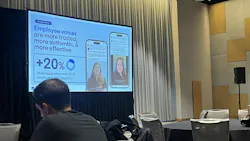
Your Customer Journey Map Isn’t Working: Build a Messaging Compass, not a Map
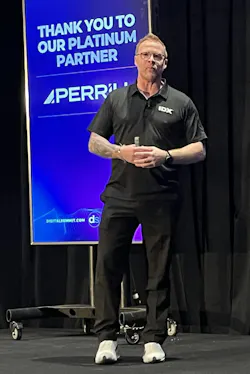
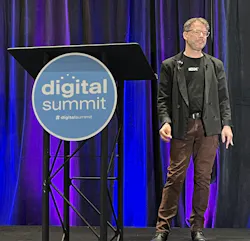
Speakers: John Triplett and Dustin Diehl, IDX
In Brief: Traditional customer journey maps are too complicated to be useful, and the solution is not to build better maps but to shift from thinking of them as static documentation to thinking of them as actionable orientation tools — more like a compass than a GPS. Triplett and Diehl from IDX walked through a stripped-down framework built around three customer life cycle stages (anonymous, prospect, customer) and three persona-defining attributes (goals, questions, pain points). This framework helps teams answer critical questions: What content should we develop? Which channels matter most? How do we allocate marketing budget? Where do we enforce messaging consistency? The framework serves as a governance tool as much as a planning tool, giving teams tangible criteria to push back against stakeholder requests that don't align with customer needs and preventing wasted effort across siloed departments.
Quote: "Organizations build journey maps that don't get used because they're too complicated, too expensive, too static and not focused on the customer — they're brand-centric instead."
Actionable Item: Decision-Making Compass — Replace comprehensive journey maps with a simple 3x3 framework (3 life cycle stages × 3 persona attributes). Use it to answer these specific questions: What content do we need? Which channels matter? How do we allocate budget? Where do we enforce messaging consistency?
Key Takeaway: B2B marketing teams should stop trying to build perfect, comprehensive journey maps and instead build simple, modular decision-making frameworks (three life cycle stages, three persona attributes) designed specifically to answer the four questions that define what they're trying to accomplish — then use that framework as governance to protect against internal misalignment and wasted effort.
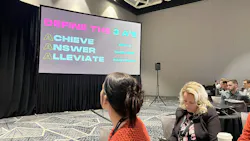
Is Your Brand Invisible to AI? How to Win in AI Search Before Your Competitors Do

Speaker: Nate Tower, Perrill Digital Marketing
In Brief: Ranking on Google does not guarantee visibility in AI search engines, and this visibility gap represents a real opportunity for B2B companies. LLM traffic converts 5-7x better than Google traffic (15-20% vs. 3%), but most brands are invisible because they don't understand how to optimize for AI-specific discovery. The framework is straightforward but requires AI-specific thinking:
- First, identify which LLMs your audience actually uses (ChatGPT dominates consumer/home services while Gemini favors Google Workspace users);
- Second, optimize your website the same way you'd for SEO but with AI-specific tweaks (front-load critical content, use TLDR sections, build industry-specific content);
- Third, pursue off-page brand mentions across the right channels (ChatGPT prioritizes Wikipedia and big media; Gemini prioritizes LinkedIn and Reddit; Perplexity prioritizes Reddit and niche blogs).
Tower supports this with specific data showing only 21% overlap between ChatGPT and Google page-one results (4% for Gemini), and the critical insight that most companies' own websites are rarely cited — third-party mentions on directories, review sites and social platforms matter more.
Quote: "Ranking on Google does not guarantee that you're going to appear in any AI search, including Gemini — Google's own platform."
Actionable Item: GEO Roadmap (Identify audience → identify which LLMs they use → audit content gaps → target third-party mentions on the platforms that specific LLM prioritizes). A practical framework that maps to SEO thinking (which B2B teams already understand) and translates the abstract concept of "AI visibility" into concrete steps.
Key Takeaway: B2B marketers need to stop treating AI visibility as a natural outcome of SEO and instead build a dedicated "GEO roadmap" that identifies which LLMs their specific audience uses, audits their presence across the right third-party platforms and directories (not just their website), and creates industry-specific content that LLMs are primed to find — because most citations in LLM answers come from sites like G2, Clutch, LinkedIn and Reddit, not from company websites.
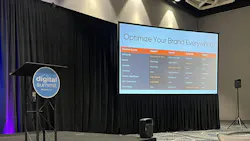
Start a Fire: Deliver Human-First Storytelling in a World of AI Noise

Speaker: Tyler Farnsworth, Campfire
In Brief: In a world of AI-generated content and content saturation, brands will stand out only by telling human stories, not by being more prolific or louder, but by being more authentic and emotionally resonant. Farnsworth frames storytelling through the "campfire" metaphor: a gathering place where humans have always shared information (from early hunter-gatherers to modern Reddit and Discord communities). The core framework consists of five story types (origin, product, customer, failure, founder) and five elements of brand storytelling mirroring campfire-building:
- Spark = emotional insight/human truth
- Tinder = hook/tension
- Kindling = structure/strategy
- Oxygen = conversation/engagement
- Fuel = depth/longevity
The key principle is identifying the emotional truth your customer carries before they ever know your product exists — not just a functional pain point, but a human problem.
Quote: "Marketing is no longer about the stuff you make, but the stories you tell."
Actionable Insights: Emotional Truth Exercise — Write one sentence answering: What is the emotional truth your customer carries before they know you exist? (E.g., "staying hydrated is a chore" for Coco5, "my brain is scattered" for Notion.) Use this as the foundation for your storytelling.
Key Takeaway: B2B marketers need to shift from thinking about what their product does to understanding the emotional truth their customer carries before they even know the product exists — and then build stories that address that human truth rather than just functional benefits, because in an AI-saturated environment, authenticity and human connection are the only real differentiators.
More From Digital Summit Chicago:
 What Recent Marketing Data Reveals About Attention and Performance
 From the Stage to Your Strategy: The Most Quotable Moments from Digital Summit Chicago
 In Photos: A Day at Digital Summit 2026
 dreamstime_xl_154593189
About the Author
 Alexis Gajewski
Alexis Gajewski
Contributor / AI Expert
Alexis Gajewski is the Associate Director of Newsroom Operations and Development at EndeavorB2B, where she leads editorial strategy and AI integration across a portfolio of 80+ B2B brands and 150 editors. With 18+ years in B2B media, she is best known for building the systems, training programs, and organizational infrastructure that help editorial teams operate at a higher level — faster, smarter, and with clearer standards.
Her expertise spans the full editorial stack — from SEO, GEO, and analytics to AI literacy, content strategy, and journalistic standards — with a particular focus on translating emerging technology into practical frameworks editorial teams can actually adopt. She designs and delivers training programs that meet teams where they are and build toward where the industry is going, with a specialty in AI integration that covers everything from foundational literacy to advanced workflows and agentic applications. A frequent guest on ASBPE webinars, Alexis is a recognized voice on the intersection of journalism and AI, and she writes for marketers, editors, and authors on how to thoughtfully and strategically implement AI practices.
 Resources
Quiz
 Your Competitive Edge, Delivered
Elevate your strategy with weekly insights from marketing leaders who are redefining engagement and growth. From campaign best practices to creative innovation and data-driven trends, MarketingEDGE delivers the ideas and inspiration you need to outperform your competition.
