Ask the SEO Help Desk: What do I do when my SEO stops working?
Who this is for:
- You're a marketer at their wit's end with organic traffic and SEO
- You're a marketer that's run out of SEO tactics to try
- You're a marketer wanting learn more about SEO and AEO
Question: I’m a marketer, and I’m running into a wall with SEO. I’ve been following all the guidance I can find: I’ve made sure my product pages have good titles and that our product descriptions include all the right keywords. I’ve asked vendors and some of the publishers who have interviewed us to make sure to link back to our website. I’ve asked our brand managers to post about our company on their social media. I’ve been doing all of this for the last few months, and my boss is wondering why our products aren’t showing up on Google’s AI pages or why we’re not showing up on ChatGPT. I’m starting to worry that it looks like I haven’t done anything to help us optimize. Do you have any advice? What am I missing?
Answer: We’ve all been there. In fact, I have yet to meet any person, group, product, brand, or company that has shouted from the rooftops: WE’VE MASTERED SEO! (never mind mastery of GEO or AEO). If someone has mastered it, I implore you to reach out to me. I have a few questions.
Now that you feel slightly less alone, let’s take a closer look at a few diagnostic tools as and a few potential areas to review.
Diagnostic Tools for Identifying Traffic Issues
Analytics Tools (Both Paid and Free)
Before we can identify areas for improvement, let’s first look behind the scenes. Whatever website analytics tools you’re using, see if you can isolate both your organic search traffic and your generative AI referral traffic for the last 12-18 months.
Organic Search Traffic: When you look at your organic search traffic, do you see a slow uptick to your product pages over a period of time, a series of peaks and valleys, or did you start strong and have since seen a decline in the last 12-18 months?
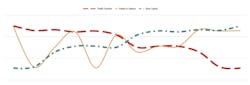
This chart represents what trends you might be seeing in your organic traffic in the last 12-18 months. Understanding what your organic traffic is telling you can help you understand where you need to look to make improvements.
- A slow uptick can tell us that we’ve gained more traffic from search engines over time. An uptick tells us the strategy we put in place is working. This is the ideal, of course, particularly if those clicks lead to leads.
- A series of peaks and valleys might indicate we’re being impacted by search engine algorithm updates. Search Engine Journal keeps an up to date list of all Google Algorithm updates, which can be helpful if we’re trying to validate our own tumultuous traffic with what Google’s doing with its search results. Peaks and valleys may also align with marketing endeavors we’ve executed.
- A decline can often represent loss of traffic due to search engines’ algorithms and/or emphasis on AI-enhanced search results.
AI Referral Traffic: Assuming you’ve allowed AI tools to access your website, if you look at your website analytics and have seen a rise in traffic from the different AI tools (which you would likely see in your Referral traffic), this can tell you that your brand or your products are being cited or scanned more in different AI outputs.
Search and Webmaster Tools (Typically Free)
Both Google and Microsoft have a version of Search or Webmaster tools that can tell you — if you’ve validated your site with these tools — how often your site is being cited in their search engines. These tools can tell you which pages are coming up in search results, how many clicks you’re receiving from them, and which queries people are putting into search to find you.
These data points can help you understand what people are searching for and whether your product pages are appearing in organic search results. This is another area where upticks, peaks and valleys, and declines can tell you if what you’re seeing in your Analytics is a result of tactical implementation, search engine algorithms, or user behaviors.
SEO Tools (Typically cost money)
Paid SEO tools like Moz, SEMRush, SimilarWeb, and ScreamingFrog can run in-depth analysis on your entire website and provide you tips and tools for how to improve your website based on their proprietary data. These can be a good option if you’re looking to invest in your site’s SEO.
Areas to Review
Based on your question, let’s presume that you’ve seen a decline in organic traffic to your website over the last 12-18 months, you’ve seen some modest growth in AI referral traffic, and you don’t have access to search/webmaster tool data, or a paid SEO tool. There are still a few things we can look at to see if there’s room for improvement.
Prompts for brand authority and entity optimization
- Tell me about [brand/product]
- What problem does [brand/product] solve, and who is it best suited for?
- Summarize [brand/product] as an AI assistant would to a new buyer.
- What misconceptions about [brand/product] might appear in AI-generated responses?
- What category does AI most often place [brand/product] in? Is that positioning accurate or limiting?
- Where does [brand/product] lack topic authority in search engines or AI engines?
- What entity associations (topics, problems, competitors, industries) are most strongly connected to [brand/product]?
Brand Reputation
You mentioned having good titles on your product pages and keywords in your product descriptions. That’s great! In this Answer Engine Optimization (AEO) era, your brand reputation is as important as your titles and keywords. In Want More Visibility in AI Search? Focus on Brand Authority, Not Just Keywords I talk about why your brand’s reputation is so important.
Trust and credibility are significant factors in your brand’s reputation. You can have perfectly crafted page titles, but if your customer service is lacking — and people are talking about it — then you’ll likely run into problems being discovered and cited by SEO and AI tools. If customers aren’t trusting you, the tools sending you traffic won’t find you credible either.
I included prompts in the sidebar to help you understand your brand’s reputation and where you might be able to identify some gaps and areas for improvement.
Entity Optimization
Entity optimization is a close companion to Brand Authority, and an often-overlooked element of SEO. Search and AI engines aren’t merely looking at your website any longer; they’re looking at your entire digital ecosystem. They’re looking at your brand, your product lines, your company leadership, which industries you serve, what problems your products solve, and what platforms, products, or technologies you integrate with.
Your goal is for your brand to be identified as a cohesive and connected network.
More on how to do that coming up soon.
Submit your questions
SEO and GEO are complex topics that can bring with them a lot of questions. If you have a question you'd like us to include, Send your questions to us and we'll include them on the site.
About the Author
 Erin Hallstrom
 Erin Hallstrom
Contributor
Erin Hallstrom is the Director of Content Operations and Visibility for EndeavorB2B, where she works with more than 150 trade journalists across 90+ brands to implement search engine optimization (SEO) and generative engine optimization (GEO) best practices. She’s been a featured speaker at the News and Editorial SEO Summit (NESS) and headlines ASBPE’s SEO for B2B Media Playbook education series.
In addition to optimization strategy, Erin is responsible for Endeavor's metrics reporting, where she uses her expertise in website analytics to help teams understand their data to make informed content decisions. Erin holds multiple technical certifications in Google Analytics and also trains audience and marketing groups how best to utilize SEO and GEO tactics for enhanced content marketing performance.
 Resources
Quiz
Submit your questions
SEO and GEO are complex topics that can bring with them a lot of questions. If you have a question you'd like us to include, Send your questions to us and we'll include them on the site.
 Your Competitive Edge, Delivered
Elevate your strategy with weekly insights from marketing leaders who are redefining engagement and growth. From campaign best practices to creative innovation and data-driven trends, MarketingEDGE delivers the ideas and inspiration you need to outperform your competition.
