Influencing International Markets with Integrity and Sector Fluency
Key Highlights
- Building trusted audiences within niche markets rather than striving for broad mass appeal can help agencies increase sector-specific credibility.
- With this approach, growth is driven by sector fluency, embedded strategic support and a retention-first approach, enabling global expansion aligned with client needs.
- Technical understanding, regulatory awareness and reputation management are prioritized to ensure credibility and influence in complex, interconnected industries.
- Adaptation to diverse media landscapes and cultural expectations is achieved through active listening and localized messaging, ensuring relevance and effectiveness across regions.

Nancy Dunnahoe is a senior consultant, North America, for Knights Media & Public Relations.
Every purposeful agency starts along the same lines. Close the communications gap. Shape market perception. Amplify brand presence. But not many form with a sole focus: to build a trusted audience among a few mission-critical markets rather than appeal to, and get lost in, the masses.
That might seem surface-level, like limiting the scale and scope of success. But considering that the maritime industry transports more than 80% of the world’s goods, scale is relative. As one of the largest supply chains and the backbone of international commerce, according to the UN Trade and Development (UNCTAD), the marine sector is truly a global enterprise, technically complex and ever-changing — and its industry voices are some of the most influential in business media.
While at Lloyd’s Register, a London-based classification and technical services organization founded in 1760, communications leader Jason Knights noticed that the agencies brought on to support PR efforts rarely had the industry chops to properly promote the energy or maritime industry’s profound impact or tell its technological innovation story with precision.
Knights Media & Public Relations was founded with the belief that complex and technical industries deserve communications experts who understand them. Today, Jason leads Knights’ high-stakes international communications program, partnering with global energy and maritime safety organizations such as the American Bureau of Shipping (ABS) to navigate growth, innovation, regulation and transition.
Why sector fluency matters across B2B media
“Our role is not just to tell stories, but to influence how markets think and how industries move,” Knights says. “Behind every response, investor announcement, thought leadership piece, media placement and global PR program, there is a team of specialists who understand complex industries and who know how to communicate them with integrity and influence.”
How did Knights Media & Public Relations (MPR) launch from scratch to having a global presence in only 5 years?
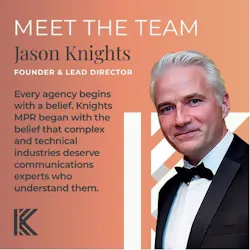
Knights: I didn’t set out to start a global agency. I set out to fix a frustration I’d seen repeatedly — world-class energy and maritime businesses being misunderstood because no one could translate what they actually did. So, we built a specialist one.
From inception, Knights positioned itself within industries that are inherently international: maritime, offshore energy, complex engineering and emerging clean technologies. These sectors operate across jurisdictions, regulatory regimes and capital markets simultaneously. If you support a client launching a new engine platform, digital drilling system or alternative fuel strategy, that conversation spans Asia, Europe, the Middle East and North America at once.
Our early growth was driven by three principles:
1. Sector fluency over generic PR capability.
We made a deliberate decision to speak the language of naval architects, drilling engineers, OEMs and shipowners. That created immediate credibility.
2. Embedded strategic alignment.
Rather than positioning ourselves as a press office, we sat alongside executive leadership, supporting capital markets messaging, regulatory positioning and technology narratives.
3. Retention-first growth.
Sustainable retainers built compounding trust. When clients expanded geographically, they brought us with them.
Global presence was therefore an outcome of delivering strategic value in industries that do not recognize geo-borders.
What gap in the market did you see that convinced you a new agency was needed?
Knights: Engineering-led companies were innovating at pace — LNG propulsion, digital drilling optimization, emissions reduction systems are a few examples — but their narratives were often fragmented, overly technical or commercially misaligned.
Highly specialized communications firms like ours must operate in the intersection between engineering depth and market positioning, where media and PR actively support customer and market adoption, investment and policy alignment.
What are some early lessons learned while shaping a specialized business?
Knights: Working within Lloyd’s Register and other companies, from PLC to small family-owned businesses, exposed me to three realities:
1. Trust is earned technically before it is earned reputationally.
In the maritime and energy sectors, credibility is tied to safety, compliance and engineering rigor. Communications that lack technical grounding are quickly dismissed.
2. Global industries demand nuanced messaging.
A regulatory development in Europe can influence shipbuilding decisions in Asia and financing structures in the Middle East. Messaging must reflect this interconnectedness.
3. Reputation is strategic infrastructure.
It underpins financing, partnerships and regulatory acceptance.
These insights guide us to prioritize technical understanding, regulatory awareness and long-term reputation architecture over short-term campaign noise.
How did you approach assembling your founding team, and what qualities mattered most?
Knights: Knights comprises a team of senior, experienced advisors who are curious enough to understand technology and confident enough to challenge clients on their products and services. The essential qualities were, and still are:
- Curiosity about complex systems and engineering processes
- Ability to translate technical detail into a commercial narrative
- Commercial awareness of how clients make money
- Emotional resilience — because crisis and regulatory sensitivity are realities in our sectors
We deliberately built a team comfortable reading technical papers, understanding machinery and engaging engineers in meaningful dialogue. That foundation differentiates us to this day.
How do you adapt your approach across different media landscapes and cultural expectations?
Knights: Adaptation begins with listening. In some regions, trade media dominates. In others, financial press drives narrative. In certain markets, public positioning must be cautious and technically conservative; in others, innovation leadership is celebrated. We never export a single narrative. Messaging must align with:
- Regional regulatory priorities
- Investor and buyer maturity
- Media structure (trade-led vs. commercial and paid-for-led coverage)
- Cultural attitudes to innovation and risk
Technical credibility is universal, but storytelling must be localized.
How has the definition of public relations changed since you started?
Knights: Public relations used to be about visibility. Today it’s about validation. In sectors like energy transition or advanced fuels for shipping, stakeholders demand trust. That shift has moved PR closer to strategy, policy and investment narratives.
Our work increasingly informs business strategy, not just messaging. We focus on influence, not noise, and we measure influence, not impressions.
How is AI reshaping what clients expect from an agency?
Knights: AI is making content easier to produce, but harder to trust. Our value increasingly sits in interpretation, accuracy and context — the human layer that ensures communications stand up to scrutiny and ethical judgment in regulated, high-stakes industries. That elevates the advisory role of agencies like ours.
How do you define success in the evolving media and PR landscape?
Knights: If Knights is still recognized 20 years from now as a firm that helped complex industries explain themselves during a period of enormous change, that will be success.
About the Author
 Nancy Dunnahoe
Nancy Dunnahoe
Contributor
Nancy Dunnahoe is a Folio Eddie award-winning writer and contributing editor with 17 years of experience in business communications. Nancy has developed technical and commercial content across the energy, maritime, and industrial manufacturing sectors. She previously built and scaled the content marketing function for a Fortune 500 chemical distribution company into an award-winning platform. Prior to her corporate career, she was an upstream online news editor and associate managing editor for oil and gas publications. A creative leader with a business sensibility, Nancy holds a BA degree in English-Creative Writing from the University of Houston Honors College and an MA in Arts Leadership from the Kathrine G. McGovern College of the Arts at the University of Houston. She is also a Certified Texas Master Naturalist.
 Resources
Quiz
 Your Competitive Edge, Delivered
Elevate your strategy with weekly insights from marketing leaders who are redefining engagement and growth. From campaign best practices to creative innovation and data-driven trends, MarketingEDGE delivers the ideas and inspiration you need to outperform your competition.
