The Shift From Metrics to Meaning: Why Marketers Are Refocusing on Customers

New research emphasizes the importance of understanding customer needs and behaviors over traditional metrics like ROI, highlighting how deeper customer insights can lead to more effective marketing strategies and higher-quality leads.
April 6, 2026
3 min read

Key Highlights

  • Nearly half of the surveyed professionals prioritize understanding customer needs over measuring ROI for marketing success.
  • Deep customer insights enable better personalization, targeting and lead quality, especially when budgets are limited.
  • Focusing on relationship-building and data analysis can outperform traditional marketing tactics and larger budgets.
  • Most marketers believe that improved data and audience insights are more impactful than new tools or increased spending.
  • Listening to customers and understanding their motivations is crucial for creating meaningful, long-term marketing relationships.

Prefer to Listen?

In your busy workday, it’s easy to get swept up by data. What was the open rate of that email campaign? How many leads did this content generate? How many conversions resulted from these efforts? While these metrics are a clear way to measure impact, before long, you run the risk of turning your customers into numbers. 

Increasingly, marketing leaders are shifting priorities and stepping back to better understand the people behind the numbers. 

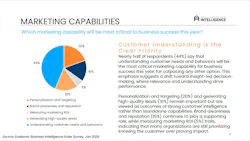
Endeavor Business Intelligence recently surveyed more than 750 professionals across a wide range of industries to gain insight into their professional priorities, marketing and business strategies, and operational challenges. When asked which marketing capability will be most critical to business success this year, nearly half (44%) of respondents ranked understanding customer needs and behaviors as the most critical.

Personalization and targeting came next at 20%, followed by generating high-quality leads (16%), and brand awareness and reputation (15%). Measuring marketing ROI lagged at only 5%, revealing that most marketers are prioritizing understanding customers over proving the impact of their efforts.

So, what does this mean for your team? Instead of asking how to generate more leads, start by asking a more important question: Do we really understand our customer? For example, while many marketing teams are excited to use AI-driven tools that enable better personalization, this only works when you truly know your audience (and you have the data to inform that knowledge). Further, lead quality improves when you actually know who to target.

The first step is to revisit how your team collects customer data. Instead of settling for surface-level metrics, dig deeper to analyze customer behaviors. Slow down and take the time to talk with your customers and develop your relationship with them. Learn more about their motivations, pain points and goals. This deeper understanding will help you make better use of your time and resources, allowing your team to focus on high-quality, long-term clients rather than burn out chasing quantity. 

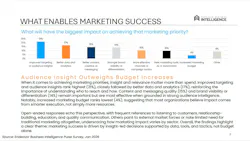
When budgets are tight and audiences are flooded with creative marketing tactics across every platform, slowing down to get to know your audience and their specific needs could make or break your strategy. Fortunately, this isn’t something that takes a big budget or fancy tools. In fact, when asked what would have the biggest impact on achieving marketing priorities, increased budget ranked lowest (4%), followed by new marketing tools, AI and automation (10%).

Rather, improved targeting and audience insights (21%) and better data and analytics (17%) lead the way. “Open-ended responses echo this perspective, with frequent references to listening to customers, relationship building, education and quality communication,” EBI analysts wrote. “Others point to external market forces or note limited need for traditional marketing altogether, underscoring how marketing impact varies by sector.” 

The takeaway for B2B marketing leaders is straightforward: Better marketing starts with better understanding. Those who lead the way may not have the biggest budgets or the noisiest presence, but the ones who know their audiences best and act on those insights. Without that foundation, more spend and a bigger footprint only make weak spots easier to see. 

On a crowded playing field, listening more closely to customers may be your smartest competitive advantage.

About the Author

Leah Marxhausen

Leah Marxhausen

Contributor

Leah Marxhausen is a content manager with Endeavor Business Media’s Content Studio, where she leads the development and execution of custom B2B content programs across all of Endeavor’s markets. She partners closely with clients, subject matter experts, and internal teams to deliver high-quality, insight-driven content.

Leah is particularly passionate about helping clients tell meaningful stories that perform — combining strong editorial standards with strategic GEO and SEO optimization to ensure content reaches and resonates with the right audience. She brings a detail-oriented, collaborative approach to every stage of the content life cycle.

Quiz

mktg-icon Your Competitive Edge, Delivered

Elevate your strategy with weekly insights from marketing leaders who are redefining engagement and growth. From campaign best practices to creative innovation and data-driven trends, MarketingEDGE delivers the ideas and inspiration you need to outperform your competition.

marketing-image