
Starting your AI journey can feel overwhelming, especially in today’s fast-moving landscape. On one side, self-proclaimed experts hype AI’s benefits, warning that anyone who fails to adapt will be left behind. On the other, cautious traditionalists urge a slower approach, highlighting risks like job loss, ethical pitfalls, and overreliance on technology. For marketers, this constant back-and-forth can make it hard to know what to believe or how to integrate AI responsibly and effectively.
With so much conflicting information out there, it’s easy to get lost in the hype. Your clients have questions, your team wants answers, and without a clear understanding of AI, making strategic decisions can feel daunting. That’s why we’ve put together this guide: to debunk the most common AI myths and give you practical insights for using AI in marketing ethically, efficiently, and confidently.
Debunking Common AI Myths in Marketing
Here are some of the most common misconceptions marketers have about AI — and the facts you need to make it work for your team
Myth: AI is going to replace marketers.
Fact: This is a common fear whenever new technology is introduced, and AI is no exception. It’s a disruptive innovation with seemingly limitless potential — and that can feel intimidating. But AI isn’t here to replace marketers; it’s here to make their lives easier. When used correctly and responsibly, AI can handle the mundane, repetitive tasks that eat up your time, freeing you to focus on strategy, storytelling, and brand growth. The true value of AI lies in collaboration, as combining its efficiency with human insight produces the best results.
Myth: AI will damage audience trust.
Fact: Using AI can damage the reputation you’ve built with your audience, but only if you use it incorrectly or unethically. First and foremost, be transparent about how you use AI. Having a well-crafted AI policy available to your audience is a simple way to outline how you do and don’t use AI in your marketing efforts. Making it clear that anything generated by AI is proofread and fact-checked by a human is another effective way to build confidence in your marketing programs. When used responsibly, AI can actually strengthen trust by improving personalization, relevance, and consistency across your campaigns.
Myth: AI-generated copy can be used as-is.
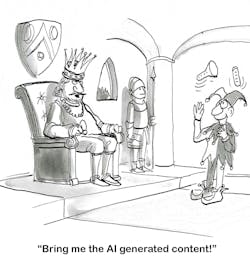
Fact: If you take away only one thing from this post, let it be this: You must always proofread whatever AI generates. The thought of letting AI run your campaigns with little to no oversight can be appealing, especially when you have a well-crafted prompt that consistently performs well, but don’t give in to temptation. AI outputs must be fact-checked to preserve the integrity of your program and your reputation. Always refine, edit, and adapt AI-generated copy to fit your brand voice, audience expectations, and campaign objectives.
Myth: Using AI makes your marketing less creative.
Fact: AI shouldn’t be used to generate your entire marketing campaign. If it is, your efforts may come across as generic, artificial, or robotic — and they won’t resonate as strongly with your audience. Like any tool, the purpose of AI is to enhance the creative work your marketing team is already doing. Use AI to help you brainstorm fresh ideas, test new messaging angles, and uncover insights faster, but make sure your team provides the human spark — the storytelling, emotion, and intuition — that turns those ideas into authentic, engaging marketing. Balance AI-generated concepts with human judgment to ensure your campaigns remain original and compelling.
Myth: AI only benefits big marketing teams.
Fact: Every day, I see ads for new AI-based marketing tools that promise all-in-one systems, enterprise-level visibility, and unbeatable results. This kind of positioning can make smaller or independent marketing teams believe that, because they can’t afford a platform with all the bells and whistles, AI isn’t for them. But nothing could be further from the truth. When you have a small team or limited resources, AI (even free versions) can take on the responsibilities of an additional team member, helping you do more with less, such as drafting social posts, generating email copy, and analyzing campaign performance. AI levels the playing field, giving small teams access to capabilities that were once only feasible for enterprise-level marketing departments.
Myth: AI will instantly make marketing easier.
Fact: Unfortunately, very few initiatives deliver instant results, and integrating AI into your daily workflow can feel cumbersome at first. In fact, when you start using AI, it might even feel like more work than doing the task yourself. This is often the point when marketers give up and conclude that AI isn’t for them. AI can make your marketing efforts faster and more efficient in the long run, but only after you’ve learned to craft detailed prompts, engage in productive interactions with AI, and refine its output to align with your brand and goals. Start small, experiment frequently, and gradually integrate AI into more complex tasks to see tangible benefits.
Myth: AI knows your brand and audience automatically.
Fact: AI has access to a seemingly limitless amount of information, but that doesn’t mean it will automatically tailor its output to your desired audience. You must provide the AI with the necessary information about your brand (tone of voice, core messaging, values, style guidelines) and your audience (industry, job roles, pain points, preferred content formats) to ensure that it generates copy and ideas that will integrate seamlessly into your marketing efforts. You can accomplish this by providing a brief summary of your brand and audience, offering examples of previous marketing efforts, or sharing specific campaign goals and messaging priorities to guide the AI’s output.
About the Author

Alexis Gajewski
Contributor / AI Expert
Alexis Gajewski is the Associate Director of Newsroom Operations and Development at EndeavorB2B, where she leads editorial strategy and AI integration across a portfolio of 80+ B2B brands and 150 editors. With 18+ years in B2B media, she is best known for building the systems, training programs, and organizational infrastructure that help editorial teams operate at a higher level — faster, smarter, and with clearer standards.
Her expertise spans the full editorial stack — from SEO, GEO, and analytics to AI literacy, content strategy, and journalistic standards — with a particular focus on translating emerging technology into practical frameworks editorial teams can actually adopt. She designs and delivers training programs that meet teams where they are and build toward where the industry is going, with a specialty in AI integration that covers everything from foundational literacy to advanced workflows and agentic applications. A frequent guest on ASBPE webinars, Alexis is a recognized voice on the intersection of journalism and AI, and she writes for marketers, editors, and authors on how to thoughtfully and strategically implement AI practices.
 Resources
Quiz
 Your Competitive Edge, Delivered
Elevate your strategy with weekly insights from marketing leaders who are redefining engagement and growth. From campaign best practices to creative innovation and data-driven trends, MarketingEDGE delivers the ideas and inspiration you need to outperform your competition.
