AI Prompt Building for B2B Marketers: From Basics to Best Practices
Key Highlights
- Strong AI prompts are now a core marketing skill—not a technical one: B2B marketers don’t need coding experience to get high-quality AI outputs; they need clarity, context, and structure in how they communicate with the tool.
- Treat AI like a junior teammate and give it full context: Industry nuances, audience pain points, brand voice, and campaign goals must be spelled out; AI only produces on-strategy content when marketers provide the right inputs.
- Effective prompts use mix-and-match components that guide tone, role, audience, and intent: Defining persona, audience, industry, format, tone, and exclusions dramatically improves content accuracy and usefulness across channels.
- Asking for variations accelerates testing and creative iteration: Prompts that request multiple options help marketers compare angles, sharpen messaging, and speed up campaign development.
- Building a reusable prompt library becomes a competitive advantage: With practice, marketers can create reliable prompts that boost efficiency, strengthen cross-channel consistency, and improve campaign performance.

Generative AI is shaking up every industry, but for B2B marketers, it’s an absolute game-changer. Need to tighten ad copy, write a personalized email, brainstorm campaign ideas, or produce social posts in seconds? AI can help you do it all while keeping your campaigns on time, on budget, and on point.
But let’s be honest: Sometimes using AI feels like scaling a mountain with no map. You’re clinging to each rocky foothold while your peers are lounging at the summit, somehow churning out better, faster results. The secret isn’t that they’re tech wizards or AI experts. It’s that they know how to talk to the tool. They’ve mastered the art of the prompt.
You don’t need to be fluent in code or even particularly tech-savvy to get great results from AI. You just need to know how to ask the right questions.
What Is an AI Prompt, and Why Is Crafting the Right Prompt So Important?
An AI prompt is the set of directions you give the tool to get the results you want. Keep in mind, not all prompts have to look the same to be effective. Consider prompt length. Some prompts are short and snappy, while others are packed with details and directions. Background and context also play an important role. You might supply the AI with paragraphs of background information, or just a handful of carefully chosen keywords that define your industry and audience. And structure matters, too. Some prompts work best as open-ended questions that spark creative ideas, while others shine when you break things down step by step, guiding the AI through exactly what you want it to do.
Regardless of a prompt’s length or structure, the key is to be clear and precise when giving instructions to AI. Think of AI as a junior marketer on your team. Would you hand an inexperienced coworker vague directions and hope for the best, or would you give them the full picture — background on the project, a clear description of the audience, the strategy you want to pursue, and the intended results? The second approach is obviously the one that’s going to produce the outcomes you’re aiming for, and the same logic applies to AI. The more specific and structured your guidance, the better the tool can deliver exactly what you need.
Even though AI is incredibly powerful, it cannot read your mind. It doesn’t automatically know industry terminology, audience behavior, or your brand’s voice. If you want AI to understand something, you have to spell it out in the prompt. That could mean including context about the audience’s pain points, key messaging your brand always emphasizes, or details about the type of content you want it to generate. Treat the AI like a teammate: The more relevant information you give, the stronger its output will be.
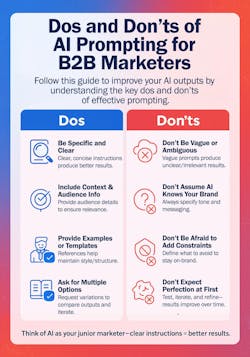
Key Components of Effective AI Prompts Every Marketer Should Use
Now that you understand the what and the why behind crafting strong AI prompts, it’s time to dive into the how. If you’re new to AI, don’t worry. You don’t need to craft the perfect prompt right out of the gate. The goal isn’t perfection; it’s progress. To help you get started, I’ve put together a list of key AI prompt components. When combined thoughtfully, these elements can help you create prompts that are detailed, clear, and more likely to produce the results you want.
Not every component will be necessary for every prompt, and that’s okay. Think of this list like an à la carte menu at your favorite restaurant: Pick and choose the ingredients that make sense for your specific project or request. Over time, as you experiment and practice, using these components will start to feel natural, and you’ll find yourself drafting effective prompts faster and with more confidence.
Define the AI’s Role or Persona
Why It Matters: Telling the AI what role to assume frames its tone, perspective, and expertise. This helps ensure the content matches the knowledge and style of the intended role.
Example: “Act as an experienced B2B email marketer.”
Specify the Intended Audience
Why It Matters: Including audience details ensures content is relevant and resonates with the right people. It helps the AI adjust tone, examples, and messaging for maximum impact.
Example: “Your audience is marketing directors at mid-sized agencies who manage multiple campaigns and are responsible for reporting on performance metrics.”
Include the Industry or Vertical
Why It Matters: Defining the industry ensures that terminology, examples, and benefits align with sector needs. It allows the AI to tailor content for the challenges and language of that vertical.
Example: “Use terminology and examples that are specific to the healthcare industry, and ensure the content addresses the unique challenges hospitals face, such as data security, regulatory compliance, and patient care optimization.”
State the Purpose or Goal
Why It Matters: Clearly defining the objective ensures the output supports specific business outcomes. It guides the AI to focus on the result you want to achieve, such as registrations, leads, or conversions.
Example: “Write an email promoting our upcoming webinar to operations managers in fintech, designed to drive registrations. Highlight key takeaways such as improving transaction efficiency and regulatory compliance and include a clear CTA to register.”
Specify Tone and Style
Why It Matters: Tone guides how the content is perceived, be it professional, approachable, authoritative, or conversational. This ensures the messaging aligns with your brand voice and audience expectations.
Example: “Use a professional and approachable tone that builds trust while remaining easy to read. Avoid overly casual or humorous language and maintain clarity so the content is suitable for an executive audience.”
Set Length or Format Expectations
Why It Matters: Including constraints on length or format ensures the output fits your medium or channel. It also helps avoid overly long or off-format content that needs heavy editing.
Example: “Write a 150-word product description and format the description in three short paragraphs.”
Provide Examples or Reference Points
Why It Matters: Providing a reference or template helps the AI match style, structure, or level of detail. It gives the AI a concrete example to emulate, improving consistency and quality.
Example: “Using this email as a model: ‘Boost efficiency with X software — schedule a demo today,’ write a new promotional email for our marketing analytics platform targeting mid-sized agencies.”
Include Key Messages or Points to Cover
Why It Matters: Specifying critical messages ensures important product features, benefits, or data are included. It prevents the AI from missing essential content that must be communicated.
Example: “Include these key points: 1) real-time reporting, 2) automated insights, 3) customizable dashboards. End with a CTA to schedule a demo.”
Ask for Several Options/Variations
Why It Matters: Requesting multiple versions encourages creativity, comparison, and helps you choose the best approach. This allows teams to test or iterate on messaging for optimal impact.
Example: “Write three alternative ad copy versions for our AI-driven workflow software targeting marketing agencies. Each version should highlight a different benefit — time savings, improved collaboration, or client satisfaction — so the team can choose the most effective approach.”
Specify Constraints or Exclusions
Why It Matters: Clearly define what should be avoided in the output, such as jargon, certain words, or styles. This ensures content remains on-brand and appropriate for your audience.
Example: “Do not use buzzwords like “synergy,” “game-changer,” or “cutting-edge,” and avoid overly casual or humorous language.”
AI Prompt Examples You Can Apply Today
With the à la carte menu of prompt components in mind, it’s time to combine the elements into a complete recipe. Pick the right ingredients, mix in context and audience insights, and add a dash of tone and structure, and suddenly you’ve got a prompt that’s ready to perform.
Here’s a look at a few fully plated prompts in action:
Example 1: Product Description for Marketing Automation Tool
Prompt: Act as a senior B2B product copywriter for marketing technology. Your audience is marketing managers at mid-sized companies. The vertical is marketing automation software. Write three alternative 150-word product descriptions, each emphasizing one of these benefits: 1) campaign optimization, 2) reporting efficiency, 3) time savings. Your goal is to convert website visitors into trial users. Use a concise, persuasive, and professional tone. Reference this prior description: “Optimize campaigns and save time with X software.” Include key messages: AI-powered insights, customizable dashboards, and actionable recommendations. Provide multiple options and avoid buzzwords or vague claims.
Example 2: Ad Copy for Enterprise Workflow Automation
Prompt: Act as a B2B ad copywriter for enterprise software. Your audience is IT directors and operations managers at mid-sized companies. The vertical is enterprise SaaS. Write three alternative ad copy concepts, each under 50 words, highlighting one of these benefits: 1) reduced errors, 2) improved collaboration, 3) faster project completion. The goal is to generate leads for a new workflow automation product. Use a professional and persuasive tone. Use the following ad as a reference for style: “Streamline your workflow with X platform — see results fast.” Ensure all key features are included: automation, scalability, and reliability. Do not mention unrelated software or services.
Example 3: Webinar Description for Healthcare Tech Platform
Prompt: Act as a B2B marketing content specialist with experience in healthcare technology. Your audience is hospital administrators and data analysts focused on patient outcomes. The vertical is healthcare analytics. Write three alternative 100-word webinar descriptions, each emphasizing one angle: workflow efficiency, risk mitigation, or patient engagement. Your goal is to drive webinar registrations on predictive analytics for population health. Use a clear, actionable, and trustworthy tone. Reference this prior webinar description for structure: “Learn how X platform can improve outcomes and streamline workflows.” Include key points: 1) predictive insights, 2) actionable recommendations, 3) time-saving automation. Do not use casual language or emojis.
From Good to Great: Leveling Up Your AI Prompt Skills
Remember, effective prompt building isn’t something you master overnight. It’s a skill that develops with practice. Don’t aim for perfection right out of the gate; focus on experimenting, testing, and refining until you start seeing the results you want. Each prompt you write will teach you something new about how AI thinks and how you can guide it more effectively.
Over time, you’ll build a library of proven, reusable prompts that become your secret weapon, helping you save time, elevate campaign quality, and deliver more consistent results across every channel. Ready to put these principles into practice? Open your AI tool and try writing a prompt using one of the templates above. Track your results, tweak, and repeat. Your marketing campaigns will thank you.
Want the EDGE delivered to your inbox every week?
It's free to subscribe, but the intel is priceless.
Need a cheat sheet for building successful prompts? Click here!
About the Author
 Alexis Gajewski
Alexis Gajewski
Contributor/AI Expert
With 18+ years in B2B media, Alexis Gajewski is best known for building the systems, training programs, and organizational infrastructure that help editorial teams operate at a higher level — faster, smarter and with clearer standards.
Her expertise spans the full editorial stack — from SEO, GEO and analytics to AI literacy, content strategy and journalistic standards — with a particular focus on translating emerging technology into practical frameworks editorial teams can actually adopt. She designs and delivers training programs that meet teams where they are and build toward where the industry is going, with a specialty in AI integration that covers everything from foundational literacy to advanced workflows and agentic applications. A frequent guest on ASBPE webinars, Alexis is a recognized voice on the intersection of journalism and AI, and she writes for marketers, editors, and authors on how to thoughtfully and strategically implement AI practices.
 Trending
 Your Competitive Edge, Delivered
Elevate your strategy with weekly insights from marketing leaders who are redefining engagement and growth. From campaign best practices to creative innovation and data-driven trends, MarketingEDGE delivers the ideas and inspiration you need to outperform your competition.
