How to Make Every Session, Conversation and Coffee Break Count at Your Next Conference
Key Highlights
- Prepare thoroughly before the event by walking the venue, reviewing session notes and setting clear goals to maximize productivity and reduce reactive behavior.
- During sessions, focus on capturing data-backed claims, actionable tactics and audience reactions, while using AI tools for transcription and note organization to stay engaged and thoughtful.
- Post-session, process notes immediately to create content assets like summaries, quotes and validation queues, enabling quick sharing and internal briefing to amplify event impact.
- Engage in meaningful conversations between sessions by approaching speakers and vendors with specific questions and connecting on LinkedIn to build lasting professional relationships.
- Dedicate 30 minutes at the end of each day to identify patterns, publish real-time content, and review goals, ensuring continuous learning and content momentum from the event.
Covering an industry event well happens in three stages: before, during and after. This article covers the during. Catch up with Part One: The Pre-Event Strategy Every B2B Marketer Needs (And Almost Nobody Builds), or jump ahead to Part Three: How Smart Marketers Turn One Conference Into Three Weeks of High-Value Content.
Every year, marketers descend on convention centers across the country with the same optimistic agenda: Attend every session worth attending, meet everyone worth meeting and come home with enough insights to justify the registration fee, the flights and the three days out of the office. It's an ambitious plan. It rarely survives contact with the actual event.
The problem isn't the conference. It's the approach. Most marketers treat attending as a passive activity. You show up, you listen, you collect. But the marketers who consistently walk away with the most value treat it as an active one. They're not just attending sessions. They're documenting, analyzing, publishing and building relationships in real time, all while everyone else is wondering where the good coffee is.
If you're already prepped and ready to go, here's how to make every minute count with AI handling the heavy lifting so you can stay focused on the conversations and insights that matter most.
What to Do Before You Walk Into Your First Session
Most attendees treat the time before the first session as dead time — a chance to grab coffee and find a seat. It isn't. What you do in the 30 minutes before the day officially begins sets the tone for everything that follows.
Arrive early enough to walk the venue before it fills up. Find your session rooms, locate the exhibitor floor and identify where the power outlets and quiet corners are. Logistical friction costs more than most attendees realize. Not knowing where you're going, running between rooms or sliding into the back row because you arrived late doesn't just waste time. It puts you in a reactive mindset before the first session even starts.
While you're at it, take a few photos of the venue — the signage, the registration area, the energy of the space before the crowds arrive. These establishing shots become the visual foundation of your social content and give your coverage a sense of place that photos taken midday rarely capture.
Once you've walked the space, spend 10 minutes on four things:
- Review your briefing document. Skim your session notes and speaker backgrounds for the day. Remind yourself what business problems you came here to solve, what questions you're walking into each session with and what your team or leadership needs you to come back with.
- Check the event hashtag and LinkedIn. See what people are already talking about. This includes which sessions are generating buzz, which conversations are already happening and whether there's anything worth adjusting in your plan before the day starts. While you're there, check the engagement on any pre-event content you published. Are there comments worth responding to or conversations worth joining?
- Make sure your tools are ready. Open your recording app, load your note-taking system and check your battery level. Discovering your transcription app isn't working or your phone is at 15% in the first five minutes of a session is a frustrating and avoidable distraction.
- Set a concrete goal. What is the single most important thing you need to walk away with today? A decision made easier, a contact made, an answer found? Write it down. Everything else is a bonus.
Finally, introduce yourself to the people around you before sessions start. The person sitting next to you is a potential peer, collaborator or future client. The speaker grabbing coffee at the same station is more approachable now than they will be after their session, when a crowd is vying for their attention. A 30-second conversation costs nothing, and the best professional relationships often start in exactly these moments.
How to Get the Most Out of Every Session You Attend
Once you're in your seat, the focus shifts from preparation to observation. Here's how to get the most out of every minute you spend in the room.
Sit near the front and toward the aisle. It keeps you focused, makes you visible to the speaker and gives you quick access to approach them when the session ends without navigating a crowd.
Once you're settled, let your recording app do the work. AI-powered transcription tools will capture everything verbatim so you don't have to. Your job isn't to transcribe. It's to think. Use your notes for reactions, observations and questions the transcript won't capture. The moments where something surprises you, where you disagree, where you see an application for your own organization. Those are worth writing down. The verbatim content isn't.
As you listen, train yourself to notice four things specifically:
- Claims backed by data. Specific statistics, benchmarks and research findings are the moments most worth capturing and most worth validating before you bring them back to your team or use them in your own content.
- Tactics and frameworks you can actually use. The best sessions give you something you can implement. When a speaker shares a specific process, methodology or approach, note it immediately and ask yourself whether it's relevant to a current challenge at your organization.
- Positions that challenge your current thinking. When a speaker argues something that contradicts how you or your team currently operates, that's worth capturing. It might validate a change you've been considering or surface a blind spot you didn't know you had.
- Audience reactions. Applause, skepticism, the questions people ask — these tell you as much about what matters to your industry as anything said on stage. If a room full of marketers reacts strongly to a specific claim, that's a signal worth noting.
Be selective about photographing slides. Not every slide deserves a photo. Focus on the ones with specific data points, frameworks or strategic recommendations you'll want to reference later.
Put your phone down when you're not actively capturing something. It makes you a better observer and a more memorable presence in the room. And if there's a Q&A, use it. A well-framed question — specific, grounded in what was actually discussed and connected to a real challenge your organization is facing — puts you in the room as a contributor rather than just an attendee. It gets you noticed by the speaker and the people around you in a way that passive attendance never will. For marketers building authority in their space, that visibility compounds over time.
The Post-Session Workflow That Most Attendees Skip
Don't wait until the end of the day to process your notes. Do it now, while the session is still fresh. It takes about 10 minutes and produces four assets you'll use across every piece of content you create, every internal briefing you write and every conversation you have about the event afterward.
 dreamstime_xl_44657725
 dreamstime_xl_1742545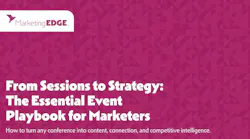
Paste your transcript or notes into AI and work through them in this order:
- Clean your transcript. Ask AI to fix grammar, punctuation and obvious transcription errors while preserving the speaker's voice. Ask it to flag anything unclear or inaudible rather than guessing. What you get is a clean, readable record you can share with colleagues, reference in content or use to brief your leadership team.
- Summarize the session. Ask AI for a one-paragraph summary that leads with the most important point, not a chronological recap. Ask it to identify the five to seven most substantive claims with a note on whether each was supported by data, asserted without evidence or appropriately hedged — and to flag what's immediately actionable versus what's useful context. This summary becomes the backbone of every piece of content and every internal communication you produce from this session.
- Extract your quotes and key takeaways. Ask AI to pull the strongest quotes and most actionable takeaways in two tiers — Tier 1 being the three to five most compelling and self-contained, Tier 2 being three to four that are strong but need more context. For each, ask for a note on where it's best used — a blog post, a LinkedIn update, an internal team briefing or a client-facing summary. You'll know exactly what you have before you write a single word.
- Build a validation queue. Ask AI to extract every specific claim, statistic or data point from the session and organize them by how urgently they need verification — high, medium or low. Before you repeat a statistic in a meeting, use it in a presentation or publish it in a piece of content, you need to know where it came from. This queue tells you exactly what needs checking and what's safe to use immediately.
Once you have these four assets, you're ready to publish something. Ask AI to draft two or three LinkedIn post options based on your session summary, pick the one that best reflects your perspective, and edit it in your own voice. The best real-time posts don't just document what a speaker said. They add your perspective as a marketing professional. What does this mean for how you approach your work? What would you push back on? What surprised you given what you know about your market? That's what builds authority. Not being a live-tweet machine, but being a thinking presence at the event.
Why the Best Conference Conversations Don't Happen on Stage
The conversations that happen between sessions are often more valuable than the sessions themselves. This is where marketers speak candidly about what's actually working, share war stories that never make it onto a slide deck and make the peer connections that turn into referrals, partnerships and long-term professional relationships. Don't spend this time on your phone. Spend it talking to people.
A few specific things worth doing in the time between sessions:
- Approach speakers right after their talk. The crowd thins out quickly, and speakers are often more candid in conversation than they were on stage. Have one specific question ready. Not a compliment, but a question grounded in something they actually said. Reference a claim you want to explore further or a recommendation you want to pressure-test against your own situation. It signals you were paying attention and gives the conversation somewhere meaningful to go.
- Connect on LinkedIn in the moment. Don't collect business cards with good intentions. Pull up LinkedIn, connect while you're standing with the person, and send a one-line note about what you talked about. You'll thank yourself later when you're trying to remember who said what.
- Pay attention to what vendors are saying on the floor. The exhibitor area tells you a lot about where the market is heading — what problems vendors think buyers have, what messaging is resonating, and which categories are getting crowded. Walk it with intention, not just to collect swag.
How Smart Marketers End Every Conference Day
Most people end a conference day exhausted and ready to decompress. That's understandable. But 30 intentional minutes at the end of the day will make everything you produce significantly better and save you hours of work later.
Here's how to spend those 30 minutes:
- Do a quick AI debrief. Paste your session summaries from the day into AI and ask it to identify patterns. What themes came up across multiple sessions? What topics did every speaker seem to be circling without addressing directly? What surprised you given your existing knowledge of the market? This daily synthesis is where your post-event analysis begins to take shape and where you start identifying what's worth bringing back to your organization versus what's noise.
- Publish your same-day content. Session recaps, LinkedIn posts, photo galleries — publish them today, not tomorrow. Real-time content performs better and positions you as an informed, on-the-ground voice while the event is still relevant to your audience. If you processed your notes after each session, you already have everything you need. This should take 30 minutes, not three hours.
- Reflect on your goals. Did you get what you came for? Did you have the conversations you needed to have? Did you walk away with something you can bring back to your team or apply to a current challenge? If not, adjust tomorrow. A conference is two or three days. There's still time to course correct.
- Review tomorrow's schedule with fresh eyes. Look at it informed by what you learned today. Are there sessions worth adding based on themes that emerged? Speakers worth prioritizing after hearing their work referenced in today's talks? Update your plan. The briefing document you built before the event is a starting point, not a contract.
If you followed the system in this article, you're leaving the event with something most marketers don't have — structured assets, processed notes, and a clear picture of what the event actually meant for your industry. Part Three of this series, How Smart Marketers Turn One Conference Into Three Weeks of High-Value Content, is where you put all of it to work.
DOWNLOAD: From Sessions to Strategy: The Essential Event Playbook for Marketers gives you a roadmap across three phases — before, during and after the event. Each phase is built around a set of checklists and ready-to-use AI prompts that do the heavy lifting, so you can stay focused on the conversations and insights that no amount of prep work can manufacture.
Download this playbook and work through it front to back before your first event, then return to each phase as a quick reference when you need it.
Ready to turn any conference into content, connection and competitive intelligence? Download our free playbook today!
About the Author
 Alexis Gajewski
Alexis Gajewski
Contributor / AI Expert
Alexis Gajewski is the Associate Director of Newsroom Operations and Development at EndeavorB2B, where she leads editorial strategy and AI integration across a portfolio of 80+ B2B brands and 150 editors. With 18+ years in B2B media, she is best known for building the systems, training programs, and organizational infrastructure that help editorial teams operate at a higher level — faster, smarter, and with clearer standards.
Her expertise spans the full editorial stack — from SEO, GEO, and analytics to AI literacy, content strategy, and journalistic standards — with a particular focus on translating emerging technology into practical frameworks editorial teams can actually adopt. She designs and delivers training programs that meet teams where they are and build toward where the industry is going, with a specialty in AI integration that covers everything from foundational literacy to advanced workflows and agentic applications. A frequent guest on ASBPE webinars, Alexis is a recognized voice on the intersection of journalism and AI, and she writes for marketers, editors, and authors on how to thoughtfully and strategically implement AI practices.
 Resources
Quiz
 Your Competitive Edge, Delivered
Elevate your strategy with weekly insights from marketing leaders who are redefining engagement and growth. From campaign best practices to creative innovation and data-driven trends, MarketingEDGE delivers the ideas and inspiration you need to outperform your competition.
